
When slurry density influences process performance
Slurry density changes with operating conditions in grinding, classification, flotation and thickening. Periodic sampling can miss the variations between laboratory checks. Alia ADM provides continuous bulk density measurement directly in the pipeline, where process engineers and control systems need reliable information.
What continuous density measurement helps reveal
Changes between samples
Detect density variations that may otherwise go unnoticed between laboratory checks.
Unstable classification
Additional cyclone feed density data to assess operating conditions in the circuit.
Inconsistent thickening
Monitor thickener feed and underflow density trends.
Limited automation data
Provide a continuous signal for trends, alarms and control after integration.
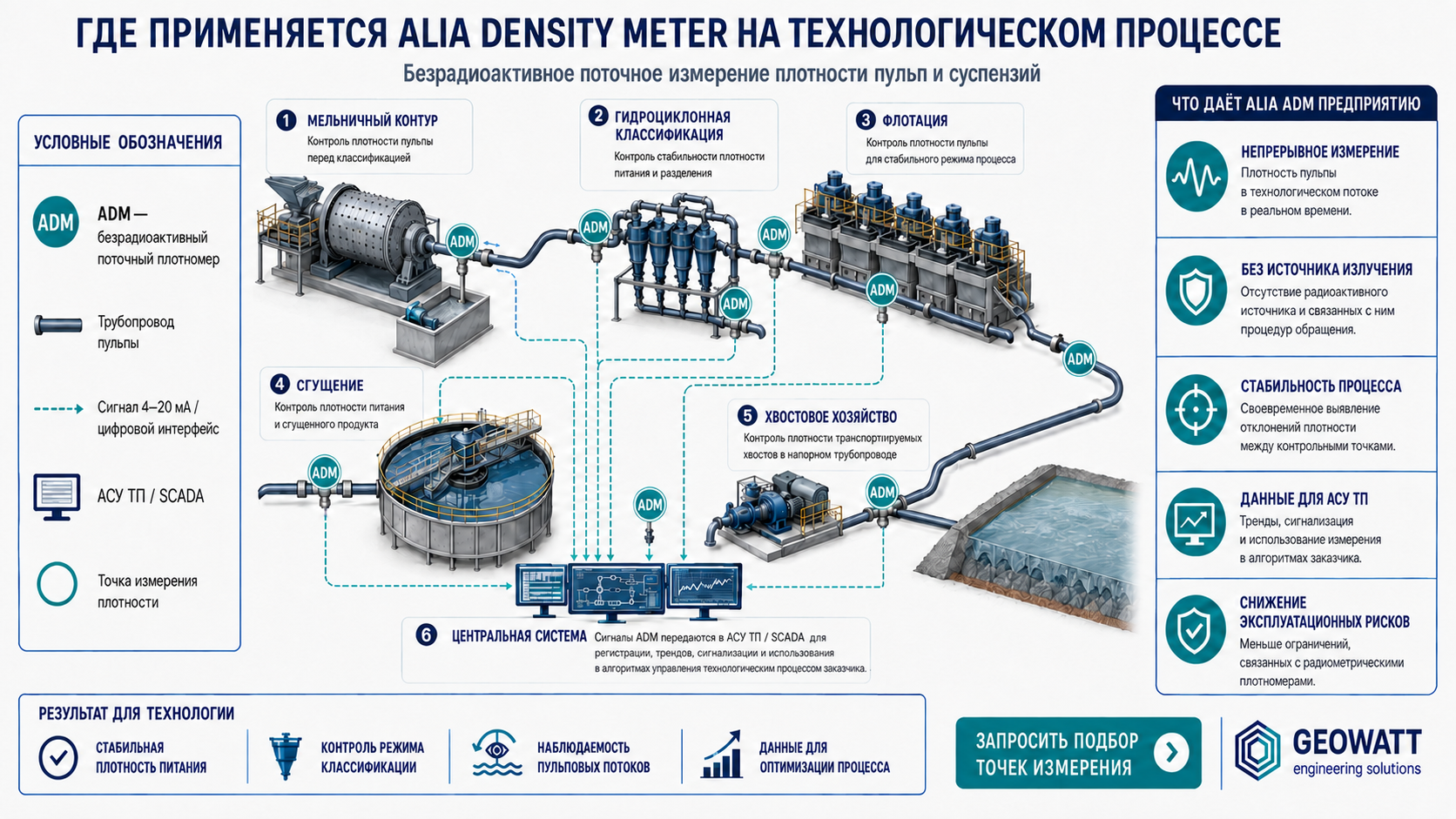
Typical Alia ADM applications in mineral processing
Grinding and classification
Measure density in mill circuits and cyclone feed pipelines.
Flotation
Monitor slurry density at selected feed and transfer points.
Thickening and dewatering
Track density changes in feed and thickener underflow.
Tailings and hydraulic transport
Monitor the density of transported slurry and variations along the line.
How the technology works
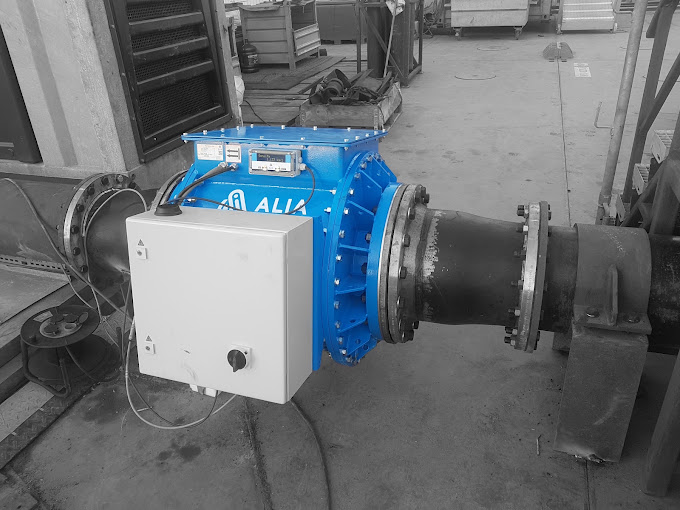
Alia ADM uses a mechanical measurement principle based on the dynamic response of a measuring section to controlled excitation. It determines the bulk density of the flowing medium without a radioactive source. The method is designed for industrial slurries, including abrasive mixtures; suitability for each installation is assessed against process conditions.
Other industries where slurry density matters
Mining and mineral processing
Ore slurries, concentrates, tailings and mineral suspensions.
Dredging and hydraulic transport
Sand-water mixtures and transported sediment.
Oil and gas services
Drilling and cementing fluids in relevant applications.
Tunnelling
Bentonite and excavated-ground suspensions.
Chemical and power industries
Mineral sludges and process suspensions.
Water and waste treatment
Sludge lines, sediments and slurry transport.
Suitability is reviewed individually, considering medium composition, entrained gas, pipe geometry, temperature, pressure and installation conditions.
What different plant teams gain
Process engineers
Continuous visibility of density changes during operation.
Instrumentation teams
An inline non-nuclear measurement option for suitable applications.
Automation teams
A signal for display, logging and control logic.
Technical management
Information for evaluating control points and upgrades.
Discuss your measurement point
Tell us about the process area, medium and problem to solve. GeoWatt can review the suitability of Alia ADM and identify the input data needed for selection.
How an engineering assessment begins
Define the location, density variation and measurement goal.
Review process conditions and installation requirements with the manufacturer.
Align instrument configuration, integration and next steps.
Technical specifications
Detailed specifications, installation requirements, instrument configurations and ADM technical documentation are available in GeoWatt’s restricted area for registered users with approved access. This public page focuses on the technology and its applications.
Download Alia ADM Technical Specifications ↗
Already registered? Open the restricted section
Registration does not guarantee immediate access. If access is not enabled, please contact GeoWatt.
Considering Alia ADM for your plant?
Start with your operational challenge. GeoWatt can help structure the technical discussion around your process.
A density meter alone does not directly measure mass flow. Flowmeter data and a suitable calculation model are also required.