
Power supply reliability is part of production reliability.
A feeder outage can interrupt crushing and mineral processing, stop conveyors, or disrupt dewatering and pumping. To act before a problem develops and investigate incidents effectively, the electrical team needs comparable information from remote circuits as well as the main substation.
GeoWatt develops industrial power network monitoring solutions using Synaptec technologies. We translate operational requirements into measurement locations, system architecture, equipment supply and integration with the site's infrastructure. Working from Almaty, we support projects in Kazakhstan and Central Asia, including Uzbekistan and Kyrgyzstan.
Where the solution fits into an industrial site
A mining and processing complex is a clear example of a distributed power network. The main substation, processing plant, crushing facilities, conveyors, tailings facilities and pumping stations all support one production process. GeoWatt's illustration shows potential measurement locations and the operational questions they can help address.
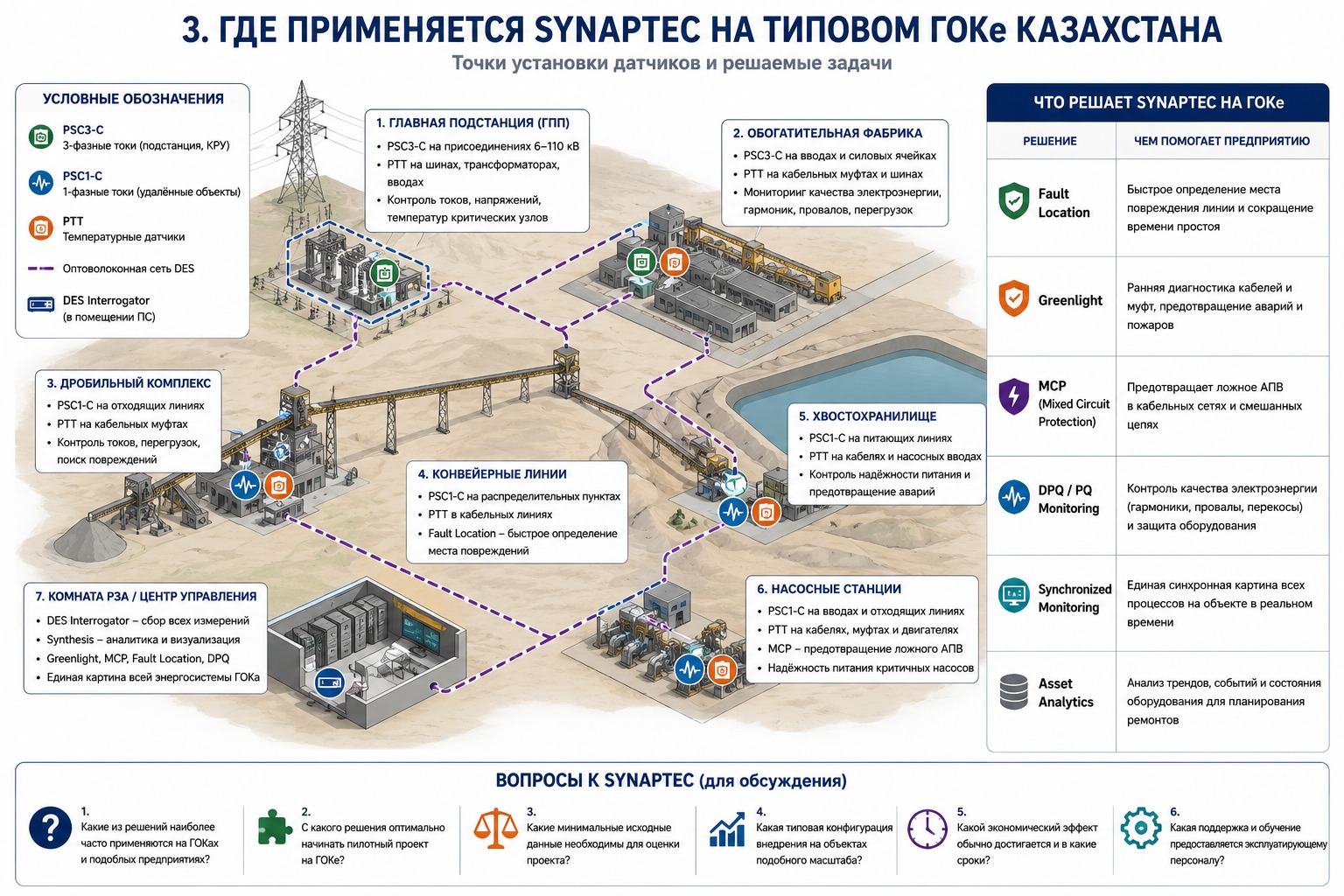
Main substation
Monitoring scopeIncoming circuits, bus sections, outgoing feeders and selected temperature measurement points.
Operational purposeEstablish a reference view of the site's supply and compare it with events at remote facilities.
Processing plant
Monitoring scopeSupply feeders, switchgear panels and critical cable accessories.
Operational purposeInvestigate supply disturbances affecting process equipment and prioritise inspections.
Crushing facilities
Monitoring scopeOutgoing circuits, cable joints and circuits with recurring trips.
Operational purposeCompare equipment starts, load changes and fault events by time and location.
Conveyor routes
Monitoring scopeDistribution points and key sections of long supply circuits.
Operational purposeNarrow the fault search area and direct maintenance teams to the relevant section.
Tailings facilities
Monitoring scopePower supplies to remote facilities and critical pump incomers.
Operational purposeImprove visibility at locations where loss of supply affects process continuity.
Pumping stations
Monitoring scopeIncomers, outgoing feeders, cable joints and accessible temperature measurement points.
Operational purposeUse evidence about the supply network to select appropriate reliability improvements.
Protection room and control centre
Monitoring scopeInterrogators, analytics, event storage and agreed integration interfaces.
Operational purposeProvide a shared information base for electrical, protection, control room and maintenance teams.
This approach is not limited to mining. It can also be considered for metallurgical plants, large manufacturing sites and other facilities with distributed loads, extensive cable networks and costly downtime. The system scope follows the network and its operational requirements, rather than the site's industry classification.
How Synaptec's distributed measurement system works
Distributed Electrical Sensing (DES) delivers synchronised electrical measurements from multiple remote locations over optical fibre. The passive converters at measurement points need no local power supply; interrogation and digitisation take place centrally. Interrogators and server equipment still require power.
What the system can address
Greenlight: cable and accessory condition monitoring
Greenlight correlates electrical and temperature data to identify indications of cable system deterioration. Relevant inputs include phase currents, screen currents, joints, terminations and screen bonding arrangements. Temperature measurements complement the electrical picture; DTS is included for temperature monitoring along the route. An unusual change prompts investigation of a specific asset, rather than guaranteeing detection of every possible cable defect.
Fault Location: identifying the affected section
Distributed measurements support monitoring zones and identification of a faulted branch or section in a complex network. For maintenance teams, this enables a more targeted investigation. Identifying a faulted zone and locating a defect to a distance in metres are different requirements: the required resolution and location method must be agreed during engineering.
MCP: selective auto-reclose blocking on mixed circuits
Mixed Circuit Protection (MCP) distinguishes faults in the cable and overhead sections of a mixed circuit. A fault in a monitored cable section generates an auto-reclose block; the agreed auto-reclose logic remains available for overhead sections. MCP is not a universal function for every pumping station: its suitability depends on circuit topology and the existing protection scheme.
Synchronised analysis of network behaviour and power quality
Measurements at several locations help compare events and harmonic content. For an industrial project, we consider this approach as a basis for investigating large loads, converter equipment and network disturbances. Voltage sag assessment requires voltage measurement channels; the parameter list and measurement class requirements are specified separately.
Synthesis: visualisation, events and operational analytics
Synthesis provides tools for viewing synchronised waveforms, recording events and analysing trends. Electrical teams can use these to compare behaviour across the network and build an operational history. The project defines user access, archive retention and how information is passed to other site systems.
Integration with existing infrastructure
GeoWatt's task is to establish how the new solution will work alongside existing protection relays, SCADA and industrial control systems. Monitoring signals, measurement data exchange and protection commands are treated separately because their latency, availability and testing requirements differ.
Instrument circuits:
assess existing CTs and VTs, secondary circuit access and the requirements for new measurement points.
Optical fibre:
review routes, spare fibres, connections, optical budget and redundancy requirements.
Protection:
agree zone boundaries, signal logic and testing with the installed protection devices.
Supervisory control:
define signal lists, addressing, interfaces and event presentation.
IT and operations:
specify server location, access, data storage, support and cybersecurity requirements.
The use of IEC 61850, including GOOSE and Sampled Values, is checked against the selected equipment and configuration. A capability in a manufacturer's product range does not automatically establish compatibility with every device on site.
What a GeoWatt project delivers
The objective is a coordinated solution for a specific power network, not simply a list of sensors. Subject to the agreed scope, project deliverables may include:
- a review of the existing network and a prioritised list of operational requirements;
- a measurement location plan, monitored zone boundaries and system architecture;
- selection of equipment, fibre connections and software functions;
- integration, installation space and infrastructure preparation requirements;
- a supply specification and phased implementation plan;
- a test programme, acceptance criteria and operating documentation requirements.
Supply, installation, commissioning, training and ongoing support are included as agreed. Responsibilities between GeoWatt, the manufacturer and installation contractors are defined before implementation.
Start with a focused pilot, then expand
Define the problem.
Select a circuit or asset where trips, difficult diagnostics or critical loads justify greater visibility.
Design the pilot.
Agree measurement points, equipment, interfaces and installation constraints at the operating site.
Verify the outcome.
Assess data completeness, event capture, diagnostic usefulness and integration against an agreed test programme.
Plan the next stage.
Use the pilot results to decide which circuits to add and which functions operations teams actually need.
How to assess the operational and financial value
The business case should use site-specific evidence. For a pilot, we suggest agreeing measurable criteria in advance:
- time from an event to identification of the monitored section requiring investigation;
- fault investigation and supply restoration time;
- the extent of manual inspections and visits to remote assets;
- recurring trips with established causes;
- the effect of power interruptions on production and maintenance planning.
Information needed for an initial proposal
- a single-line diagram, voltage levels and critical load list;
- circuit lengths, joint locations and boundaries between cable and overhead sections;
- CT, VT and protection relay details, including available secondary circuits;
- the fibre network layout or information on available fibres;
- SCADA interfaces and requirements for data hosting;
- outage history, current diagnostic methods and the intended project outcome.
If some information is not yet available, start with a single-line diagram and a description of the problem. This will help establish what is needed for the next stage.
Discuss your project with GeoWatt
Send us the supply network diagram and a short site description. We can discuss the priority circuit, a possible Synaptec architecture, pilot boundaries and the engineering scope. GeoWatt supports solution selection and equipment supply from Almaty for industrial enterprises in Kazakhstan and Central Asia.